

Table of Contents
- Start With a Wardrobe Audit, Not a Shopping Spree
- How to Build a Capsule Wardrobe That Actually Gets Worn
- Styling Tips for Different Body Shapes
- How to Choose Comfortable Heels for Standing All Day
- The Finishing Layer: Colour, Texture and Accessories
- Where Expert Fashion Advice for Women Gets It Wrong
- Making It Work: A Practical Plan for Your Wardrobe
- Frequently Asked Questions
Last Updated: September 23, 2026
Start With a Wardrobe Audit, Not a Shopping Spree
Here's how to run the audit:
- Pull everything out of your wardrobe and drawers
- Try each piece on in front of a full-length mirror
- Ask three questions: Does it fit now? Does it suit my life? Do I feel good in it?
- Set aside anything needing repair or tailoring
- Group what's left by category: tops, bottoms, dresses, outerwear, shoes
Once you finish, you'll spot the real gaps. That's when shopping becomes useful instead of random.
How to Build a Capsule Wardrobe That Actually Gets Worn
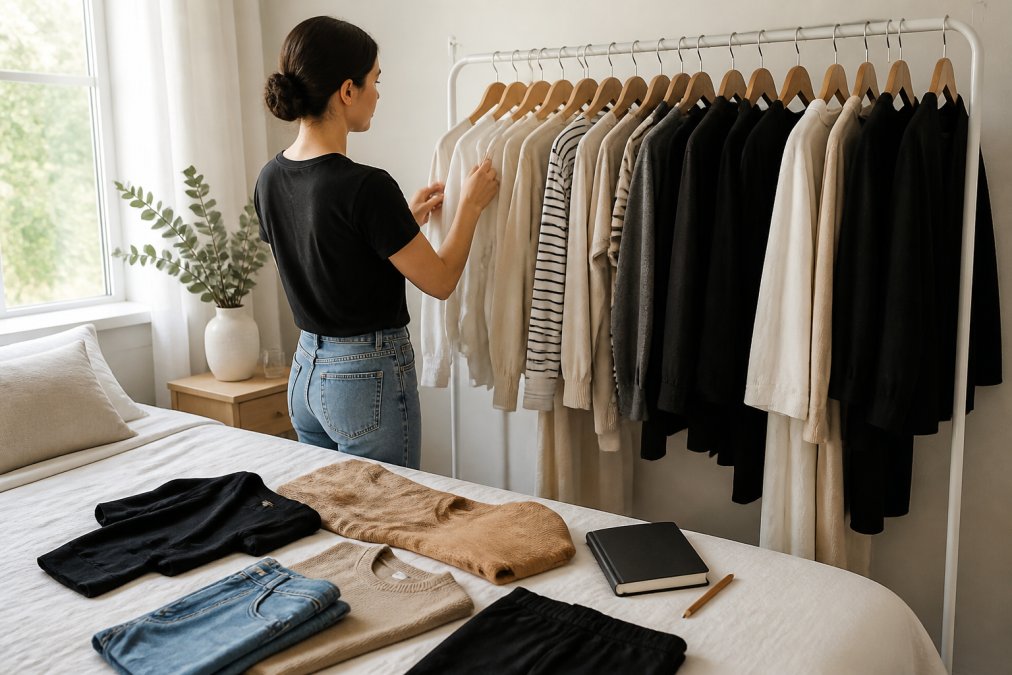
A capsule wardrobe is a small, curated set of clothes that mix and match to create many outfits.
The 3-3-3 Rule as a Starting Filter
The 3-3-3 rule is a simple filter: pick three tops, three bottoms, and three pairs of shoes that all work together, forcing you to choose items that genuinely combine rather than one-off statement pieces.
Choosing Wardrobe Staples and Investment Pieces
Wardrobe staples are the pieces you reach for weekly: a well-cut blazer, dark jeans, a plain white shirt, a midi dress, quality leather shoes.
Styling Tips for Different Body Shapes
Styling tips for different body shapes are about proportions, not rules. No body shape is a problem to fix. The aim is balance: drawing the eye where you want it and creating a silhouette that feels right.
Working With Proportions, Not Against Them
Proportion is the relationship between the lengths and volumes of what you wear. A few principles apply across every shape:
- Balance volume with structure. A loose top works with a fitted bottom, and the reverse. An oversized knit over slim jeans reads intentional; over wide-leg trousers it reads shapeless without a defined waist.
- Define your waist for a curvier line: belts, wrap dresses, and high-waisted styles all help. A belt at your natural waist is the fastest way to change a silhouette.
- Create vertical lines with monochrome dressing or long layers. An open longline cardigan or column dress does more for perceived height than any heel.
- Choose necklines that suit your frame. V-necks lengthen; boat necks widen the shoulder line; a scoop neck softens a sharp jawline.
A Four-Shape Framework You Can Actually Apply
Rather than memorising dozens of body-shape labels, most stylists work with four broad proportion patterns. Identify the one closest to your frame, then use the goal and starting pieces below as a filter, not a cage.
| Proportion pattern | What it looks like | Styling goal | Starting pieces |
|---|---|---|---|
| Balanced | Shoulders and hips roughly equal, waist defined | Maintain the line; add interest through texture | Wrap dresses, belted blazers, straight-leg trousers |
| Shoulder-dominant | Shoulders wider than hips | Add volume below, soften the shoulder line | A-line skirts, wide-leg trousers, V-necks, raglan sleeves |
| Hip-dominant | Hips wider than shoulders | Add interest up top, skim the hip | Boat necks, structured shoulders, bootcut or straight trousers, dark bottoms |
| Straight | Shoulders, waist and hips similar width | Create curve or lean into column dressing | Peplum tops, belted coats, bias-cut dresses, layered knits |
Dressing for Real Life, Not a Photoshoot
Body-shape advice fails when it ignores context. The same frame needs different solutions for a desk job, a school run, and a wedding. Ask three questions before you buy:
- What am I doing in this? A structured blazer works for meetings; a soft knit works for the school run.
- How long will I wear it? A two-hour event tolerates a heel and a fitted waist. An eight-hour day does not.
- What will I pair it with? If you cannot name three existing pieces it works with, it is a one-outfit purchase.
How to Choose Comfortable Heels for Standing All Day
The best heels for standing all day have a heel height under 6cm, a block or flared shape, and a leather lining that lets your foot breathe. Height and shape matter more than brand or price.
Heel Height, Shape and What Your Day Actually Looks Like
Think about where you'll be standing: soft grass calls for a block heel, while a long day on hard floors calls for a lower heel and a cushioned insole.
- Under 5cm: Best for full days on your feet
- 5-7cm: A good middle ground for events
- Above 8cm: Save for seated occasions and short wear
The Finishing Layer: Colour, Texture and Accessories
Colour, texture, and accessories turn a good outfit into a great one. The finishing layer is where personal style shows, and where a small budget goes furthest.
Building a Colour Palette That Works Year-Round
A workable colour palette has three parts: two neutrals, one accent, and one metallic. Neutrals carry the bulk of your wardrobe, the accent adds interest, and the metallic ties your accessories together.
| Palette role | Examples | Share of wardrobe |
|---|---|---|
| Neutral 1 | Black, navy, charcoal | ~40% |
| Neutral 2 | Cream, camel, stone, white | ~30% |
| Accent | Rust, olive, burgundy, cobalt | ~20% |
| Metallic | Gold or silver (pick one) | ~10% |
Texture and Layering Without Buying More
Texture works like colour: mixing a smooth fabric with a knit, or leather with linen, adds depth without adding colour. Layering follows the same logic, start thin, build up, keep one focal point.
Accessories Do the Heavy Lifting
Accessories do the heavy lifting. A single statement piece, such as sculptural heels or a bold earring, beats five small ones competing for attention. One focal point per outfit; let everything else support it.
- A quality leather belt in your neutral 1 colour, it defines the waist and lifts plain dresses.
- One pair of gold or silver hoop earrings, the metallic that matches your palette.
- A structured bag in a neutral, it reads more expensive than a soft tote at the same price.
- A silk or wool scarf, the fastest way to add colour and texture at low cost.
The Sustainable and Budget-Conscious Angle Most Guides Miss
Practical moves that cost little or nothing:
- Repair before replacing.
- Shop second-hand for the finishing layer. Scarves, belts, and statement jewellery are the easiest categories to buy pre-loved, because fit matters less than it does for clothing.
- Rotate, don't accumulate. Track what you actually wear for a month. Anything unworn goes into a donate or resale pile, and the gap it leaves tells you what to buy next.
- Set a yearly clothing budget and divide it by category. Spend most on staples and shoes. Spend least on trends and seasonal colours.
Fashion psychology backs this up too: what you wear changes how you carry yourself, and dressing in clothes that fit and feel good builds confidence that shows, regardless of the price tag.
Where Expert Fashion Advice for Women Gets It Wrong
The biggest problem with most fashion advice is that it ignores cost and conscience. It assumes an unlimited budget and a fresh wardrobe every season. That's not how real women dress.
Sustainable Choices and Budget-Conscious Curation
Fashion psychology backs this up too. What you wear changes how you carry yourself. Dressing in clothes that fit and feel good builds confidence that shows.
Making It Work: A Practical Plan for Your Wardrobe
A wardrobe plan only works if it's simple enough to follow. Here's a sequence you can start this week.
| Step | What To Do | Time Needed | How Often |
|---|---|---|---|
| 1 | Run a full wardrobe audit | 2 hours | Every 6 months |
| 2 | List your real gaps | 20 minutes | After each audit |
| 3 | Set a yearly clothing budget | 30 minutes | Once a year |
| 4 | Shop only for gaps | 1-2 hours | As needed |
| 5 | Book a styling session for events | 1 hour | Before big occasions |
Frequently Asked Questions
What is the 3-3-3 rule in fashion?
The 3-3-3 rule is a simple filter for building outfits: three colours, three textures, and three focal points at most. It stops you overloading a look. In practice, pick a base colour, a secondary tone, and one accent, then mix fabrics like leather, linen and knit so the outfit has depth without feeling busy. It works well as a starting point when you are learning how to build a capsule wardrobe, because it forces you to check whether each new piece actually combines with what you already own.
How do I find my personal style as a woman?
Start with what you already reach for, not what you wish you wore. Pull out the ten pieces you wear most often and look for patterns in colour, silhouette and fabric. Note the occasions you actually dress for, whether that is work, school pick-up, or formal events. Then test one new direction at a time rather than replacing everything at once. A styling session can speed this up, because an outside eye spots the consistencies in your wardrobe that you have stopped noticing.
What are the essential items every woman should have in her wardrobe?
A workable core usually includes well-fitting trousers or jeans, a tailored blazer, a plain knit or two, a dress that suits multiple occasions, a quality leather shoe, and a bag that holds your daily essentials. The exact list matters less than the fit and fabric quality of each item. A $200 blazer that fits properly outperforms three cheaper ones that pull at the shoulders. Build the core first, then add personality through accessories and seasonal pieces.
How do I choose comfortable heels for standing all day?
Look at heel height and shape before anything else. A block heel between 4cm and 6cm distributes weight far better than a thin stiletto of the same height, which is why styles like a flared block heel or a mid-height block sandal hold up through a long event. Check the lining and strap placement too, since leather lining and a buckled heel strap keep the foot stable. If you are on your feet for hours, a 4.8cm to 6cm block heel is a realistic choice; save the 8cm styles for shorter occasions.
Building a wardrobe that works takes more than a shopping trip. It takes a plan, honest decisions about what you own, and pieces chosen for your body and your life. Red Hill Collective can help with all three. Our boutique on Eyre St in North Ward offers personal styling services, a curated selection of Australian and international brands, and a café to make the visit easy. Shop All and start with pieces you'll actually wear.