
Table of Contents
- What You'll Need Before You Switch
- Natural vs Synthetic Fabric Comparison: What Actually Differs
- Why Choose Natural Clothing Fibers for Skin Health
- Breathable Fabrics for Hot Climates: Cotton, Linen, Silk and Wool
- Certifications, Traceability and Cost Per Wear
- Caring for Natural Fibre Garments So They Last
- Common Mistakes to Avoid When Buying Natural Fibre Clothing
- Frequently Asked Questions
Last Updated: September 12, 2026
What You'll Need Before You Switch
Switching to natural clothing fibers starts with auditing what you already own. Most wardrobes mix cotton, polyester, elastane and blends, and knowing which pieces you actually wear beats any shopping list.
Before you buy anything new, gather these basics:
- A tape measure for checking garment measurements against your own
- Your three most-worn outfits, to identify the fabrics you reach for
- A laundry routine that suits delicate fibres
- A budget that accounts for cost per wear, not just the ticket price
Natural clothing fibers come from plants or animals: cotton, linen, hemp and bamboo are cellulose fibers; wool and silk are protein fibers. Each behaves differently on the body, in the wash and at end of life.
Shoppers who understand fibre composition before buying keep pieces far longer than those who shop on look alone.
This guide covers how natural fibres compare with synthetics, which suit tropical heat, how to read certifications, and how to care for garments so they last for years.
Natural vs Synthetic Fabric Comparison: What Actually Differs
The core difference is structure. Natural fibers are cellulose or protein polymers that breathe, absorb moisture and break down over time. Synthetics such as polyester, nylon and acrylic are petroleum-derived plastics engineered for stretch, water resistance and low cost.
Breathability, Odour and Moisture
Breathability describes how readily air and water vapour pass through a fabric. Natural fibers have irregular, porous structures that let heat escape and moisture move away from skin; synthetics are denser and trap warmth and odour.
That odour point matters: bacteria thrive in the warm, damp film synthetics create against skin. Wool and linen resist odour naturally, so they can be worn several times between washes.
Durability, Cost and Environmental Impact
Synthetics win on tear strength and price. Natural fibers win on longevity of appearance, comfort and end-of-life behaviour.
| Factor | Natural Fibers | Synthetic Fibers |
|---|---|---|
| Breathability | High | Low to moderate |
| Moisture-wicking | Absorbs and releases | Wicks but holds odour |
| Biodegradability | Breaks down over time | Persists for decades |
| Microplastic shedding | None | Significant in every wash |
| Cost per wear | Falls with good care | Rises as pilling sets in |
Every wash of a synthetic garment releases microplastics into waterways (PubMed). Natural fibers shed too, but those fibres biodegrade rather than accumulate.
Why Choose Natural Clothing Fibers for Skin Health
Natural clothing fibers suit reactive or sensitive skin because they carry fewer chemical residues and let skin regulate temperature and moisture. Organic cotton, linen and silk are commonly recommended for eczema-prone skin.
Sensitivity often flares when moisture sits against the body or finishing chemicals contact the skin. Natural fibers absorb perspiration and release it as vapour, keeping skin drier.
Certifications help here. Look for Global Organic Textile Standard, which restricts chemical inputs across the entire textile manufacturing chain, or OEKO-TEX Standard 100, which tests finished garments for harmful substances.
For eczema or general sensitivity, the fibre matters as much as the cut: a breathable linen shirt beats any synthetic marketed as "moisture-wicking."
Breathable Fabrics for Hot Climates: Cotton, Linen, Silk and Wool
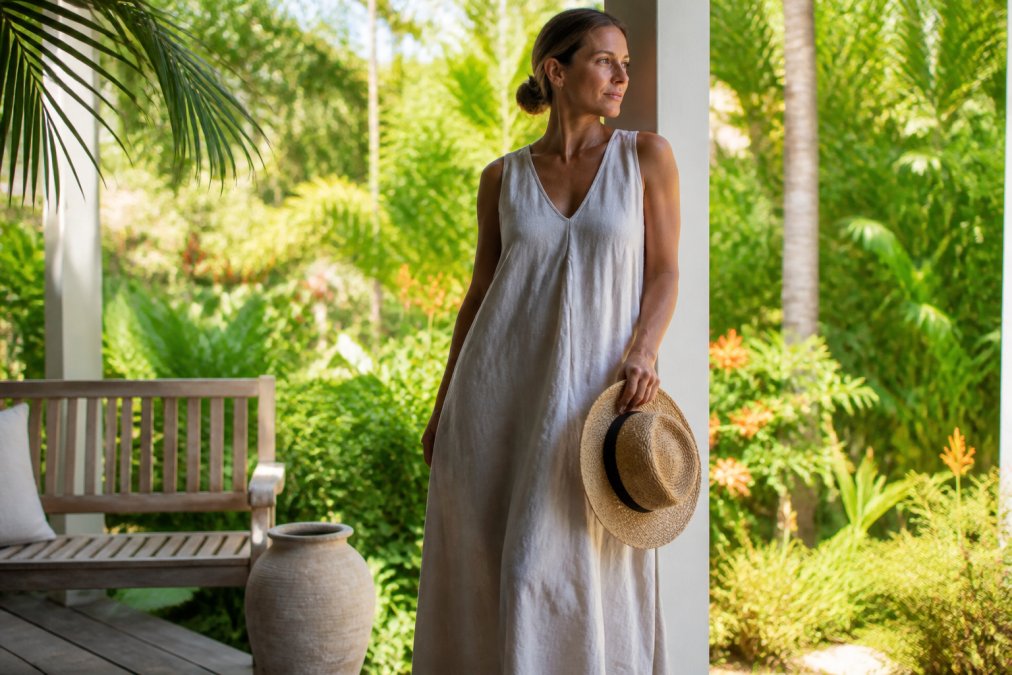
Breathable fabrics for hot climates move moisture and heat away from the body rather than trapping them. Natural fibres have irregular, porous cross-sections that absorb water vapour and release it; synthetics are smooth, hydrophobic filaments that hold warmth and odour. Linen and cotton lead for everyday humidity, silk suits evening pieces, and fine merino handles temperature swings better than most expect.
Fibre-Specific Performance Profiles
Most guides lump natural fibres together as breathable. They behave very differently. Here is how each performs in heat and humidity.
Linen (flax)
- Structure: long, straight cellulose fibres with a waxy surface and hollow core, so air moves through readily.
- Moisture: absorbs around 20 per cent of its weight before feeling damp, then releases it quickly, so it feels cool even when you perspire.
- Drying: the fastest-drying common natural fibre, which matters in humid conditions.
- Handfeel: crisp when new, softening with every wash. It creases by design, not by fault.
- Best for: daytime shirts, dresses, trousers and suiting in tropical heat.
Cotton
- Structure: shorter staple fibres twisted into yarn. The weave, not the fibre name, decides breathability.
- Moisture: highly absorbent and comfortable when dry, but slow to dry once saturated, so it stays damp against skin longer than linen in humidity.
- Handfeel: soft and versatile. Standard cotton creases; treated or blended cotton resists creasing but often loses breathability.
- Best for: everyday basics, knitwear and casual wear where softness matters more than fast drying.
Silk
- Structure: a protein filament from silkworms with a smooth, triangular cross-section that reflects light and feels cool.
- Moisture: absorbs moisture without feeling wet and regulates temperature reasonably well, but is delicate when wet and loses strength.
- Handfeel: smooth, fluid and cool, with excellent drape for evening wear.
- Best for: evening pieces, linings and lightweight layers in air-conditioned venues, not full days outdoors in humidity.
Fine merino wool
- Structure: crimped protein fibres with a scaly outer layer that traps air, insulating in both directions.
- Moisture: absorbs and releases moisture vapour, so it feels comfortable across a wider temperature range than expected, and resists odour naturally.
- Handfeel: fine merino is soft against skin; coarser wools are not.
- Best for: travel, air-conditioned offices and cooler evenings. Fine merino works in heat better than its reputation suggests, provided the micron count is low.
Matching the Fibre to the Occasion
Daytime humidity calls for linen or cotton. Formal evenings suit silk or a fine wool blend, which hold structure and drape better than lighter weaves. For travel, fine merino is the most forgiving fibre, handling temperature swings and needing less washing.
A practical rule: the looser the weave and the lighter the colour, the cooler the garment, regardless of fibre. A tightly woven dark cotton shirt will feel hotter than a loosely woven linen one.
Our team regularly guides clients toward event pieces in fibres that photograph well and stay comfortable through a long function.
Certifications, Traceability and Cost Per Wear
Certifications and traceability tell you what a garment contains; cost per wear tells you whether it was worth buying. Together they defend against fast fashion marketing.
Cost per wear is simple: divide the purchase price by the times you realistically expect to wear the piece. A well-made linen dress worn forty times costs a fraction per wear of a cheap synthetic worn five times before it pills.
Certification labels worth knowing:
- GOTS: organic status from farm to finished garment
- OEKO-TEX Standard 100: tested for harmful substances
- Responsible Wool Standard: animal welfare and land management
- EU Ecolabel and similar schemes: restricted chemical use in production
Traceability is harder: ask where the fibre was grown and the garment made. Brands that answer quickly usually have tighter supply chains.
For Australian shoppers, the Australian Competition and Consumer Commission enforces country of origin and fibre content labelling, so what appears on a care label is a legal claim, not marketing copy.
Pricing across natural fibre garments varies widely with fibre type, construction and brand, so we do not quote figures here. Check current pricing directly with the retailer or boutique.
Caring for Natural Fibre Garments So They Last
Caring for natural fibre garments comes down to gentler washing, lower heat and shade drying. Get those three right and most pieces outlast synthetic equivalents by years, though each fibre responds differently to water, heat and agitation.
Fibre-by-Fibre Care
Linen
- Wash cool or lukewarm on a gentle cycle with mild detergent.
- Tumble dry low is acceptable and softens linen, but shade line drying preserves the fibre longer.
- Iron while slightly damp on medium-hot; linen tolerates a hot iron.
- Store folded, as thin hangers distort shoulders over time.
Cotton
- Machine wash cold or warm; hot water accelerates shrinkage and fading, especially in untreated cotton.
- Tumble dry low or line dry; over-drying is the main cause of lost shape.
- Iron on medium heat while damp if needed.
- Dry knitted cotton flat to avoid stretching.
Silk
- Hand wash cool with pH-neutral detergent, or use a delicate cycle in a mesh bag.
- Never wring or twist; press gently between towels.
- Dry in shade, as direct sun yellows silk.
- Iron on the lowest setting with a pressing cloth while slightly damp.
- Store folded in a breathable bag, away from direct light.
Wool and fine merino
- Wash infrequently; wool is odour-resistant and often only needs airing between wears.
- Hand wash or use a wool cycle in cool water with wool-specific detergent; standard detergents and hot water cause felting and shrinkage.
- Never tumble dry; dry flat, reshaping gently by hand.
- Store folded, not hung, to prevent shoulder stretch. Use cedar or lavender against moths.
A Simple Routine That Works Across All Fibres
- Wash less often; air garments between wears, as wool and linen rarely need a full wash after one outing.
- Use cold water and mild, pH-neutral detergent; hot water and enzyme-heavy detergents break down silk and wool.
- Skip the dryer except for linen on low; heat shrinks wool and weakens cotton over time.
- Dry in shade; direct sun fades natural dyes and yellows silk.
- Store knits folded, not hung, to avoid stretched shoulders.
- Treat stains immediately with cool water, never hot.
Stain Treatment by Fibre
- Protein fibres (silk, wool): blot immediately with cool water. Avoid enzyme detergents, which digest protein and damage the fibre. For grease, use a little mild dish liquid on a cloth, then rinse thoroughly.
- Cellulose fibres (cotton, linen, hemp): most stains respond to cool water and mild detergent. For protein-based stains like blood, use cold water only, as heat sets them.
- General rule: test on an inside seam first, and never rub aggressively, which distorts the weave.
Why This Matters for Cost Per Wear
A well-cared-for linen shirt can last a decade or more; a similarly priced synthetic typically pills, loses shape and is discarded within a few years. The routine above converts a higher upfront price into a lower cost per wear.
Non-toxic dyes and chemical-free finishing reduce the care burden, since there is less residue to rinse away. If unsure about a piece, ask the boutique for its fibre composition and follow the care label exactly.
Common Mistakes to Avoid When Buying Natural Fibre Clothing
Most disappointing purchases trace back to a few avoidable errors. Here are the ones we see most often.
- Buying on fibre name alone. "Cotton" says nothing about weave quality, thread count or finishing; a cheap cotton shirt and a well-made one behave nothing alike.
- Ignoring the blend. A garment labelled "linen" may contain elastane. That is not automatically bad, but it changes how the piece washes and wears.
- Assuming natural means low maintenance. Silk and wool need more care than polyester, not less.
- Overlooking fit for fabric. A beautiful fibre in the wrong cut sits unworn; fit still decides cost per wear.
- Skipping the pre-wash. Sizing agents cause irritation and affect drape.
- Shopping without a plan. A sustainable wardrobe is built around pieces you will actually wear, not impulse buys.
If unsure how a fibre will behave on your body and in your climate, ask a stylist rather than guessing online. Trying a garment on answers more than any product description.
Building a wardrobe around natural clothing fibers takes more thought upfront, but the payoff is a collection that feels better, lasts longer and suits the climate you actually live in. Red Hill Collective can help you get there: our boutique on Eyre St in North Ward pairs a curated selection of Australian and international labels with personal styling services, so you can find event wear and everyday pieces in fibres that work in the heat. Browse our latest arrivals or book a styling session and let us match the right fibre to your occasion.
Frequently Asked Questions
Why is it better to wear natural fibers?
Natural clothing fibers such as cotton, linen, silk and wool come from plants and animals rather than petroleum-based synthetics. They allow air to move through the fabric, so sweat evaporates instead of sitting against your skin. Many are hypoallergenic, which suits people with skin sensitivity or eczema. They also break down at end of life rather than shedding microplastics into waterways, and they tend to hold their shape through repeated wear when cared for properly.
What are the drawbacks of natural fiber clothing?
Natural fibers crease more easily, especially linen, and some shrink if washed at the wrong temperature. They usually cost more upfront than synthetic alternatives. Wool can feel scratchy against sensitive skin, and silk needs gentle handling. Cotton grown without certification may rely on heavy pesticide use, so checking organic textiles labels matters. None of these drawbacks make natural fibers a poor choice, but they do mean you need to read care labels and budget accordingly.
How do natural fibres impact skin health and breathability?
Natural fibers let air circulate and absorb moisture rather than trapping it, which keeps the skin drier and reduces the warm, damp environment where irritation develops. Linen and cotton are the most breathable options for hot, humid conditions. Synthetics, by contrast, can hold odour and trap heat. For anyone prone to skin sensitivity, choosing chemical-free or organic textiles reduces exposure to residual dyes and finishing agents that can trigger reactions.
Are natural fibres more sustainable for the environment?
They can be, but the fibre alone does not guarantee it. Natural fibers are biodegradable and come from renewable resources, so they avoid the microplastic shedding associated with synthetic textiles. However, water use, farming methods and dye processes all affect the carbon footprint. Certifications such as organic or pesticide-free labels give you a way to check. Buying fewer, better-made pieces and caring for them well reduces textile waste more than any single fibre choice.