
Table of Contents
- Why Shop at Local Boutiques? Seven Reasons That Change How You Buy
- The Real Benefits of Shopping Local, Beyond the Slogan
- What Services Do Boutiques Offer That Chains and Online Stores Do Not?
- Personal Styling Services: How a Boutique Appointment Actually Works
- Unique Gifts From Local Shops: Better Than Another Generic Voucher
- Boutiques vs Online Shopping and Big-Box Retail: Pricing, Returns and Convenience
- How to Find and Evaluate a Local Boutique Before You Visit
- Conclusion: Shopping Local Is a Habit, Not a Sacrifice
- Frequently Asked Questions
Last Updated: October 5, 2026
Why Shop at Local Boutiques? Seven Reasons That Change How You Buy
A boutique is a small, independently owned retail store curating a limited selection of clothing, accessories or giftware, usually with staff on hand to advise on fit and styling.
This guide from Red Hill Collective sets out seven reasons that hold up in practice, from money that stays in the community to the styling help you cannot get from a warehouse listing.
The Real Benefits of Shopping Local, Beyond the Slogan
The benefits of shopping local are usually described in vague, feel-good terms. The useful version is narrower: an independent retailer keeps a larger share of each sale circulating locally than a national chain does, because ownership, staffing and suppliers sit closer to the store.
Money That Stays in the Community
Locally owned businesses spend revenue on local wages, rent, tradespeople, accountants and services. A national chain sends a larger share of takings back to head office, allocated across a national network rather than spent on the street it was earned on.
- Wages. A locally owned store pays staff who live nearby, and those wages are usually spent at other local businesses.
- Rent and outgoings. The lease, utilities and maintenance are paid to local landlords and suppliers.
- Local services. Bookkeeping, signage, alterations, cleaning and repairs are typically sourced from nearby operators.
For shoppers, the practical version is simple. Every dollar spent with an independent retailer has a better chance of paying a local wage than the same dollar spent at a big-box store.
Local Jobs and a Stronger Local Economy
Local retail employment is often part-time, flexible and entry-level, which suits students, carers and people returning to work. Those roles exist only while the store does.
The Australian Bureau of Statistics business and employment data tracks how much of the retail workforce sits in small businesses, and the share is substantial, small businesses account for the majority of employing businesses in the retail trade.
Local Ownership Is Not the Same as Local Sourcing
- Locally owned means the business is owned and run by people in the area. The profit stays close to home, even if the stock was made overseas.
- Locally made means the product itself was manufactured or crafted nearby. A store can be locally owned and stock nothing locally made, or vice versa.
Both are worth supporting, but they deliver different things. If your goal is keeping money circulating locally, local ownership is the lever; if it is supporting makers and reducing freight distances, local sourcing is the lever. A good boutique will tell you which is which.
Why This Matters More for Boutiques Than for Chains
A chain store can look small, a compact fit-out, a curated-feeling window, while still being a national operation with centralised buying, pricing and head-office staffing. A genuine boutique is independently owned, buys its own stock in small runs, and decides what to carry. That structural difference is why the money behaves differently when you spend it there.
What Services Do Boutiques Offer That Chains and Online Stores Do Not?
Boutiques offer services that scale badly, which is why chains and online stores rarely provide them. Sizing help, alterations advice, honest fit guidance and provenance information all require a person who knows the stock and has time to talk.
Sizing Help, Alterations Advice and Honest Fit Guidance
A good boutique will tell you when something does not work, staff who know how a specific label runs, which cuts suit which shapes, and whether a garment can be taken in or let out, and who will say when an alteration is not worth the cost.
Product Provenance and Support for Local Makers
Product provenance is the record of where an item came from and who made it. Boutiques can usually answer directly, because they chose the stock themselves. Stocking small-run pieces from Australian and international labels funds those makers with each order, ask where a piece was made, and a boutique should know.
Personal Styling Services: How a Boutique Appointment Actually Works
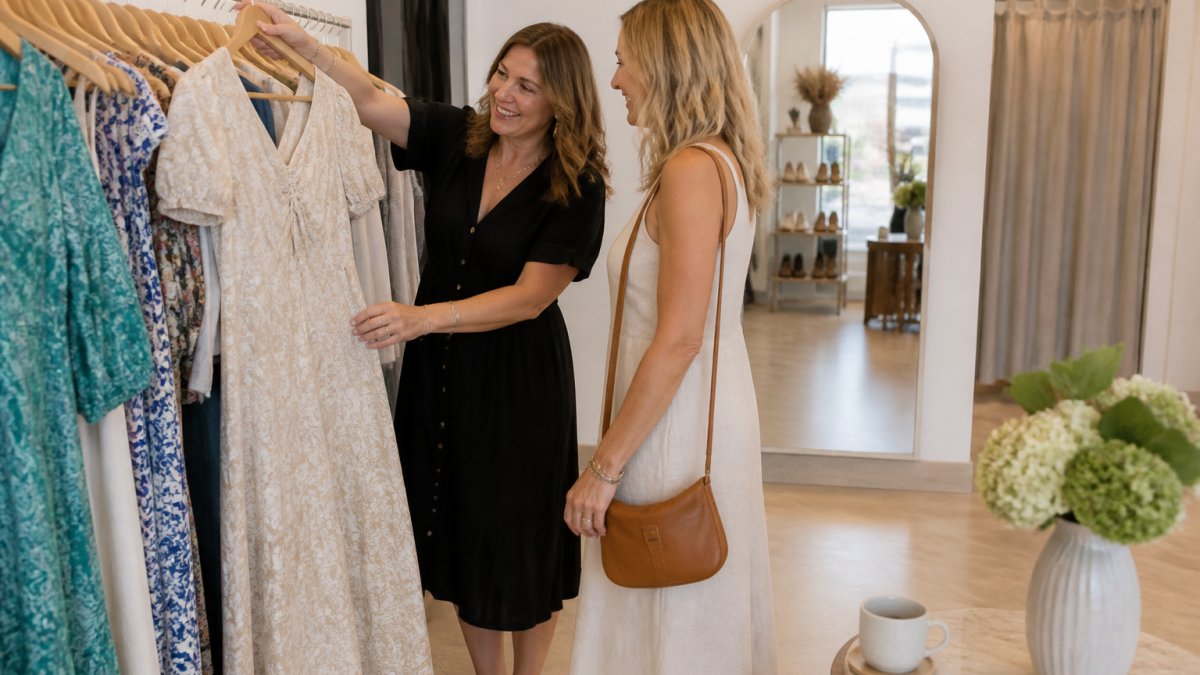
Personal styling services are appointments where a stylist pulls a shortlist of garments for you to try, based on your body shape, lifestyle and the event you are dressing for.
What to Expect in the First Ten Minutes
The first ten minutes are questions, not clothes: the occasion, what you normally wear, what you dislike and your budget. Then comes the shortlist, fewer pieces than you would pull yourself, chosen to suit the brief, with the value in what gets left off the rack. Bring the shoes and undergarments you plan to wear, because fit changes completely with the right foundation garments.
Unique Gifts From Local Shops: Better Than Another Generic Voucher
Unique gifts from local shops solve a problem vouchers cannot: they show thought. A hand-braided shopper made from recycled plastic, a piece of giftware with a story, or a scarf in a colour the recipient actually wears all beat a card with a balance on it, and you can find out where it came from, information usually impossible to get from a marketplace listing.
Provenance: The Question a Boutique Can Actually Answer
Product provenance is the record of where an item came from and who made it: which maker, which country, which materials, and whether it was a small run or mass-produced. A boutique can usually answer directly, because the owner chose the stock and often met the maker, the difference between a gift with a story and a gift with a barcode.
- Locally made gifts, ceramics, textiles, small-batch skincare, jewellery from a nearby studio, carry a maker's name and a place. They suit people who value craft and provenance.
- Locally chosen gifts, imported pieces selected by a local owner, carry the owner's taste and curation. They suit people whose style you know but whose size you do not.
Giftware That Travels Well
Giftware and accessories are the safest boutique purchase for people you do not shop for often, because they do not depend on sizing. A bag, candle, piece of tableware or scarf works across a wider range of bodies and tastes than a garment does, and nothing needs trying on or returning.
Matching the Gift to the Person
- For someone whose taste you know well: a statement piece, a printed dress, a distinctive accessory, a colour you have seen them wear.
- For someone whose taste you are less sure of: a functional object with a story, a recycled shopper, a locally made bowl, a well-made candle.
- For someone who has everything: something consumable or small-batch, ideally from a local maker, so the gift supports a person as well as pleasing the recipient.
Our Collective Evelyn Dress at $165.95 suits a gift for someone whose taste you know well, with its floral and bird print and relaxed A-line cut. If you are less certain, the Nordic Rooms Recycled Bag Small at $69.95 is the safer choice, a compact recycled carrier with a contrasting tassel that works for work, errands or the beach.


Boutiques vs Online Shopping and Big-Box Retail: Pricing, Returns and Convenience
Boutiques cost more up front than online marketplaces and big-box stores, and are less convenient to reach. In return you get fit certainty, fewer returns and advice that prevents a bad purchase.
| Factor | Boutique | Online marketplace | Big-box retailer |
|---|---|---|---|
| Upfront price | Higher | Lowest | Low to mid |
| Fit certainty | High, tried on | Low | Medium |
| Returns | Store policy, often in person | Postage at your cost | Generous, high volume |
| Styling advice | Yes, in person | None | Rare |
| Stock range | Curated, small runs | Almost unlimited | Broad, mass-produced |
| Provenance | Staff usually know | Rarely stated | Rarely known |
What You Actually Pay For
You pay for the shortlist: a boutique has already filtered hundreds of options down to the pieces worth your attention. The La Strada sheer layering shirt at $328.95 is a fair example, a lightweight open-front piece built for layering, hard to judge from a photo and easy to judge in a fitting room.

Returns, Sizing and Inclusive Shopping
Returns are the weakest point of online shopping for anything fitted: postage, delays and the risk of a garment arriving in a cut that does not suit your shape all add friction. Inclusive shopping is easier in person, see how a piece sits on your shoulders, check the length against your proportions, and ask whether a size up can be altered.
How to Find and Evaluate a Local Boutique Before You Visit
Evaluate a boutique on four things: whether the range matches your needs, whether staff answer questions directly, whether the return policy is clear, and whether the price reflects the quality of the make. Start with the stock, a boutique carrying formal and casual clothing, footwear and giftware in one space saves a second trip, then check whether it publishes return terms and offers styling appointments.
Six Questions to Ask Before You Commit
- Does the range cover what I actually need, or only occasion wear?
- Can staff tell me how this specific label runs for sizing?
- What is the return window, and are sale items included?
If a store cannot answer three of these, shop elsewhere. If it answers all six without hesitating, you have found the real thing.
The Australian Competition and Consumer Commission guidance on refunds and returns sets out your baseline rights, which apply regardless of what a store's own policy says. Worth knowing before you ask.
Conclusion: Shopping Local Is a Habit, Not a Sacrifice
The case for local boutiques is not charity. It is a straightforward trade: you pay a little more and travel a little further, and in exchange you get fit certainty, honest advice and a shorter chain between the maker and your wardrobe.
At Red Hill Collective, that relationship is the point. We offer personal styling services, a curated selection of Australian and international labels, and a boutique and café experience on Eyre St in North Ward, so a fitting can double as a morning out.
Frequently Asked Questions
What is the difference between a shop and a boutique?
A boutique carries a small, deliberately chosen range rather than hundreds of identical lines. The owner picks each piece, so you will not see the same dress on five other people that month. In practice, that means staff can tell you where a garment was made, who designed it, and how it washes. Local boutiques also tend to offer personal styling services, gift wrapping and honest advice about fit, which a large chain or a warehouse-style retailer rarely provides.
How does shopping at a local boutique support the community?
Money spent with a locally owned store recirculates through the area in wages, rent, supplier payments and local services. That keeps people employed, keeps shopfronts occupied and maintains the mix of businesses that makes a neighbourhood worth visiting. Spending locally also builds community connection: owners remember your name, know your event calendar and can hold a piece aside for you. Over time, that relationship is worth more than a small discount from a national chain.
What services do boutiques offer that online stores do not?
Most offer fitting advice, size guidance across different designer labels, and help building an outfit around one piece you already own. Many provide personal styling services by appointment, gift wrapping and gift sourcing for birthdays or weddings. Some, like Red Hill Collective, pair the shop with a café, so you can take your time and think about a purchase over coffee. Online stores give you speed and a wide catalogue, but they cannot tell you whether a cut suits your shoulders.
Is a boutique worth the price compared with cheaper high-street options?
Compare cost per wear, not the ticket price. A well-made piece that fits properly and survives repeated washing often costs less over three years than three cheap versions that lose shape. Boutique staff can also point you to pieces that suit the local climate, such as lightweight layering shirts for humid weather. Ask about fabric, construction and care before you buy, and factor in the styling advice and alterations guidance you receive at no extra charge.